Showing posts with label blue cheese. Show all posts

Thursday, April 16, 2015

Grilled Grape, Blue Cheese, and Pecan Salad with Overstuffed Carnivore Pizza


     Meat, meat, and more meat.  Oh, and there were vegetables and cheese, too!  This really was an overstuffed pizza.  Of course we needed to balance out all that heaviness with a "light" salad.  Grapes and nuts were the perfect foil for all of the richness of the main event.


OVERSTUFFED CARNIVORE PIZZA
Adapted from The Pizza Bible by Tony Gemignani

Dough:
2½ teaspoons active dry yeast
5 ounces warm water
4½ cups bread flour
¼ cup cornmeal
1 tablespoon + 2 teaspoons distatic malt
2 tablespoons lard
2 tablespoons unsalted butter
6 ounces cold water
2 tablespoons fine sea salt

Sauteed Vegetables:
6 tablespoons olive oil, divided
7 ounces thinly sliced red onion
1½ teaspoons fine sea salt, divided
8 ounces baby portabella mushrooms
1 large red bell pepper, cut into strips

Stuffing:
2 tablespoons of butter
9 ounces thinly sliced fresh mozzarella cheese
8 ounces Italian style meatballs (about 16 medium-sized balls)
2 ounces sliced pepperoni
9 ounces (uncooked) alabrese sausage (or other spicy bulk sausage)
5 ounces (uncooked) sweet fennel sausage (or other mild or sweet bulk sausage)
2 tablespoons grated Pecorino cheese
4 ounces shredded mozzarella cheese
4 ounces shredded colby jack cheese

Sauce:
3 ounces tomato paste
5 ounces canned whole plum tomatoes
½ teaspoon oregano
1 teaspoon olive oil

Finishing Touches:
1 tablespoon garlic infused olive oil
1 tablespoon of grated Pecorino cheese
1 teaspoon dried oregano
4 ounces whole milk ricotta cheese

Make the dough:  Put the yeast in a small bowl and add the warm water.  Whisk vigorously until well-combined.  Combine the flour, cornmeal and malt in the bowl of a large stand mixer fitted with the dough hook.  With the mixer running on low, add the lard and butter.  Pour in the cold water and the yeast mixture.  Continue mixing at medium speed until the dough comes together and clings to the hook.  Remove the dough and knead by hand for about three minutes or until smooth.  Using a dough cutter, cut one-third of the dough off of the ball.  Form this into a ball and place on a baking sheet, seam side down.  Form the remaining dough into a ball and place on the baking sheet, leaving at least an inch between the two balls.  Wrap plastic wrap around the pan and over the dough balls.  Refrigerate for at least 24 hours.  Bring the dough balls up to room temperature before shaping.

Sautee the vegetables:  Add 2 tablespoons of olive oil to a large skillet.  Swirl the oil around the pan to coat.  Heat the oil over medium-high heat.  Add the sliced onions and ½ teaspoon of sea salt.  Stir to coat the onions with oil.  Once the onions start to sizzle, lower the heat to medium and cook, stirring often for about 15 minutes until the onions are soft and starting to brown.  Remove from the pan.  Rinse or wipe the mushrooms with a damp cloth to clean.  Quarter the mushrooms.  Heat 2 tablespoons of oil in the same skillet used for the onions.  Add the mushrooms and ½ teaspoon of salt and stir to combine and coat the mushrooms with oil.  Spread the mushrooms into a single layer on the bottom of the pan.  Cook mushrooms until browned on all sides.  Remove them from the pan and set aside.  Heat 2 more tablespoons of oil over medium-high heat, swirling to coat the bottom of the pan.  Add the pepper strips and the remaining ½ teaspoon of salt, stirring to combine and coat with oil.  Cook peppers until they are tender and starting to brown.

Assemble the pizza:  Preheat the oven to 500º F.  Roll or stretch the larger dough ball to about a seventeen inch circle.  Spread two tablespoons of butter on the bottom and inside sides of a 15" deep dish pizza pan.  Carefully place the 17 inch circle in the pan, draping the extra dough over the edges of the pan.  Arrange the mozzarella slices over the bottom and a little up the sides of the dough.  Break up the meatballs and scatter over the mozzarella.  Arrange the pepperoni slices over the meatballs.  Pinch nickel sized pieces of each of the types of sausage and arrange over the pepperoni.  Scatter the onions, mushrooms, and peppers evenly over the sausage.  Sprinkle the Pecorino and garlic over the vegetables.  Cover with the mozzarella and colby jack.  Roll the smaller dough ball out to a fifteen inch circle.  Carefully place the circle over the toppings on the pizza.  Roll the overhanging dough from the bottom of the pizza to meet the top circle of dough, pinching the two doughs together all around the pan.  Using a sharp knife, cut two or three slits in the top dough for venting.  Transfer pizza to the oven and bake for 12 minutes.  Rotate the pan 180º and bake for another 12 minutes (you may want to put a pie ring or tinfoil around the edges of the crust if it is browning too quickly).

Make the sauce:  While the pizza is baking, start the sauce.  place all of the ingredients in a blender and puree.

Finishing Touches:  Take the pizza out of the oven and let it rest for ten minutes.  Run a butter knife or thin spatula around the edges of the pan to loosen the pizza from the pan.  With a large spatula (or two to be safe), lift the pizza out of the pan and place on a cutting board (you may want to put it on a carving board, because juices may run out when you slice it).  Brush the edges of the crust with the garlic oil.  Spoon the sauce over the top of the pizza.  Dust with another tablespoon of Pecorino.  Sprinkle with a teaspoon of oregano.  Dollop the ricotta cheese over the sauce and cheese.  Slice carefully and serve!

     This pizza was more involved than I expected.  Had I read the directions all of the way through (and had I known for sure that anyone was coming over to enjoy it), I would have done more preparing on Wednesday.  As it was, I made the dough on Tuesday, took my sausages and pepperoni out of the freezer to thaw on Wednesday, and that was about it.
     I was scrambling around when Jennifer and Roger got here on Thursday night.  I had no sauce, my vegetables weren't even cut, much less sauteed, and I hadn't even chosen a drink to accompany the meal yet.  I set both of them to work, helping me right away.  OK, I let Roger get a beer first.  Then, I sent him out to the grill with the grapes for the salad.  I set Jennifer up with a cutting board and a bucket of mushrooms.
     Again, had I read the directions all of the way through, I think I would have sauteed the onions and peppers together.  The mushrooms would have had to be done separately to achieve a nice golden brown to them and to keep all of their liquids from gooing up the onions and peppers.

I had already stretched out the dough balls, buttered the pan, and loaded the bottom dough into the pan.  I had also started sauteeing the onions.  While she worked on the mushrooms, I assembled the salad.

GRILLED GRAPE, GORGONZOLA, AND PECAN SALAD
Adapted from Patio Pizzeria by Karen Adler & Judith Fertig

2 bunches of red seedless grapes, rinsed, patted dry, and left in the bunch
2½ ounces crumbled gorgonzola cheese
3½ ounces pecans, toasted and coarsely chopped

Grill the grapes, still in their bunches, over a medium-high flame, using a screen or vegetable grilling tray, until they blister and blacken in spots, about four minutes.  Remove the grapes from the grill and allow to cool.  Remove the grapes from the step and place in a large bowl.  Add the cheese and toasted pecans.  Toss and serve.


I forced Jennifer to multi-task and start assembling the big pizza.  Layer after layer of stuff went into this thing!

     The toppings (stuffings?) had already reached the top of the pan, and we hadn't even added the vegetables and cheese yet.  We were still going, though.

     By the time we got the cheese on, it was mounded over the edge.  It was a good thing this was going to get sealed up, or we would have cheese and vegetables running all over the bottom of my oven!


     We sealed it up as well as we could, stabbed the top dough a few times with a sharp knife for venting and carefully placed it into the oven.  At the halfway mark, we opened the oven to rotate the pizza, and both Jennifer and I burst out laughing.  The dough had risen so much that it was rising right out of the pan, and it looked like a big chef's hat.

     At that point, we should have covered the outer edge with tin foil or with a pie ring, because the edges were getting brown, but we wanted to make sure that the sausage inside was cooked and all the cheese was melted.  We ended up overbrowning the edges of the pizza.


     The extra dough around the edges was helpful for the post-oven directions.  It had created a nice lip to keep in the sauce we had made while the pizza was baking and the additional cheese.


     This was really a hearty pizza.  Jennifer opted to tear the extra lip of crust off, so she could eat more of the interior of the pizza.  I used the extra crust to mellow out the richness of the meat and cheese.  Strangely enough, none of us had seconds. 

Return to the top.
Return to the Overstuffed Carnivore Pizza recipe.


Thursday, June 20, 2013

Olive Pizza Duel with Gingertinis


     I am not a great decision-maker, and I like to try new things.  One manifestation of this is that I make the next recipe in the pizza book - whatever it is.  This gets the decision-making out of the way, and we try things we wouldn't necessarily normally - just because it is the next recipe.  
    At one point in the history of pizza night, I found that if I were making two pizzas in one evening out of the same cookbook, I might frequently end up with two very similar pizzas.  Apparently, cookbook authors like to group similar recipes together.  I guess that makes sense, but I saw two similar pizza recipes from the same cookbook as some kind of parallel universe sibling rivalry.  Who is going to want to eat the plain blue cheese pizza, when there is also a garlic, blue cheese, and walnut pizza on the table?  Once, we ended up with two dessert pizzas (we, of course, ate them anyway and were happy about it).  
     Since I seemed to have a plethora of pizza-themed cookbooks (not to mention several other cookbooks that happen to have pizzas in them also), I decided (yes, a decision!) to have two books at my disposal and make one out of each every week.  At some point in the last year, I decided to throw a third book in the rotation, alternating the two new books every other week.  On a couple of occasions, two of the recipes from the separate books had turned out to be very similar - in which case, I would go on to a different recipe or use the book that wasn't "scheduled" for that week.
     Anyway, using my convoluted recipe scheduling formula, I still ended up this week with two olive tapenade pizzas.  I was marveling about this out loud while Jeff was in the vicinity and muttered something about having to decide which one to make and which recipe was going to be the non-tapenade pizza.  Jeff piped in and said I should make both and see which one we like better.  I shuttered at the thought of one pizza being left out in the cold while its other, more attractive brother was gobbled up and raved over.  However, I acquiesced, since I did not want to pick a new recipe to shuffle in or go off the "schedule" plan.
     After reading further into the recipes, I noticed that there were some obvious differences in them.  One recipe was for "tarts" or mini appetizer-sized pizzas, and the other one was a whole pie.  One was a mixed olive tapenade and the other was all kalamata olives.  The tarts had ricotta and Gorgonzola, where the whole pie had mozzarella.  
    The original recipe for the tarts called for a whole wheat crust, but I was gun-shy about making another attempt at whole wheat crust after the "rave" reviews I had from the last one.  I decided I was going to double the recipe for the crust for the whole pie and use half of the resulting dough for the tarts.  The other advantage to this was a more level playing field.  I didn't want either recipe to be ousted based on the crust.  If they were the same crust, there should be no problem there.
     
OLIVE PIZZA TARTS
Adapted from The Everything Pizza Cookbook by Belinda Hulin

3/4 cup warm water
1 teaspoon active dry yeast
1/4 teaspoon sugar
1-3/4 cup bread flour
1/2 teaspoon salt
7-1/2 ounces whole-milk ricotta cheese
1 cup mixed olive tapenade
4 ounces Gorgonzola cheese

Combine the water, yeast, and sugar in a small bowl.  Set aside for at least five minutes.  Combine the flour and salt in the bowl of a stand mixer fitted with a dough hook.  Stir together on a low speed until well combined.  Add the yeast mixture and stir at medium speed until the dough comes together, clings to the hook, and looks smooth and elastic.  Place the dough in a greased bowl and cover with a damp towel or drape loosely with a piece of plastic wrap.  Set the bowl in a warm, dry place for an hour.

Preheat the oven to 500º F.  Divide the dough into eight equal pieces.  On a cornmeal or flour dusted board, roll or stretch each piece out to a four inch circle.  Press each portion into a lightly greased tart pans, spreading the dough evenly up the sides of the pans (alternatively, if you do not have tart pans, pinch the edges of the dough up to form a rim and place on a greased baking sheet).  Divide the ricotta up evenly among the tarts, spreading them across the center of the tart.  Top this with two tablespoons of tapenade for each tart, followed by 1/2 an ounce of Gorgonzola cheese.  Bake for 10-15 minutes or until dough is browned and cheese has started to melt and brown.  Remove from the oven and let stand for 10 minutes before serving.

     I started out, thinking I was going to cook the tarts directly on a cookie sheet when I remembered that I actually have tart pans.  There was a previous recipe that had called for tart pans, and I didn't have them, so I did the cookie sheet method and had told my sisters about the inadequacy of my kitchen equipment.  Shortly thereafter, they bought me two sets of tart pans (for a total of 12 pans) for my birthday.  Have I mentioned that I love my sisters?

8 four-inch dough circles Tart Dough - Side View


     Even though I couldn't quite get the dough to fit in the pans just right, these were infinitely cuter than the flat disks they were before.  I hoped that their cuteness didn't give them an unfair advantage in the judging phase of the evening.
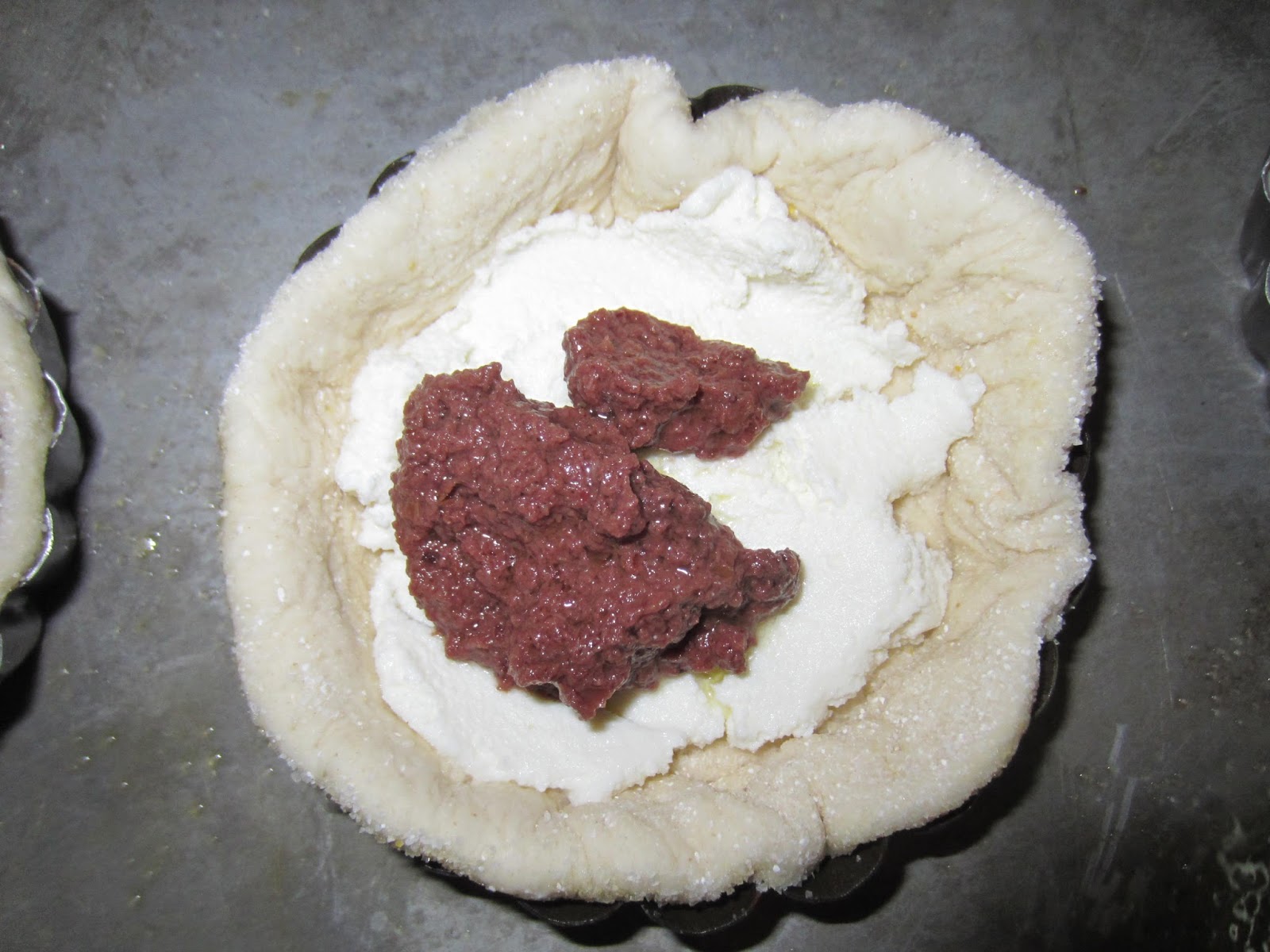
     Looking at the amounts of ricotta and tapenade, I didn't think that it would fill the tart very well, but it did.  I had to use the back of a spoon to sort of mush the ricotta to cover the bottom of the tart without ripping the dough.  I used the same method to spread the tapenade over the ricotta, so they didn't combine.  I wanted the layered effect.

8 filled tarts sitting pretty in their pans One Tart with Ricotta and Tapenade

     Next came the Gorgonzola (which I don't think is actually a true Gorgonzola, since it was made in Wisconsin).  I thought this, too, was a little skimpy, but I was going to trust the measurements.

One Oven-Ready Olive Pizza Tart Olive Tart Gang

TAPENADE PIZZA
Adapted from All the Best Pizzas by Joie Warner

3/4 cup warm water
1 teaspoon active dry yeast
1/4 teaspoon sugar
1-3/4 cup bread flour
1/2 teaspoon salt
1 cup Kalamata olives
1 teaspoon anchovy paste
1/4 cup olive  oil
8 ounces mozzarella cheese
1 teaspoon grated orange zest

Combine the water, yeast, and sugar in a small bowl.  Set aside for at least five minutes.  Combine the flour and salt in the bowl of a stand mixer fitted with a dough hook.  Stir together on a low speed until well combined.  Add the yeast mixture and stir at medium speed until the dough comes together, clings to the hook, and looks smooth and elastic.  Place the dough in a greased bowl and cover with a damp towel or drape loosely with a piece of plastic wrap.  Set the bowl in a warm, dry place for an hour.

Preheat the oven to 500º F with a pizza stone inside, if using.  On a cornmeal or flour dusted pizza peel or board, roll or stretch the dough out into a 14 inch circle.  Combine olives, anchovy paste, and olive oil in the bowl of blender.  Puree until mixture becomes a rough paste.  Spread paste over the prepared dough, leaving a small bare border around the outside edge of the pizza.  Cover the tapenade with the mozzarella. Sprinkle the orange zest over the cheese. Bake for 5-10 minutes or until cheese starts to brown.  

     I was anxious to see if the home-made tapenade was better than the purchased tapenade.  Mine was definitely smoother than the store-bought variety, thanks to my VitaMix.


     While the tarts were cute (as I have already mentioned), the large pizza had a certain elegance to it, with the contrasting colors of the mozzerella and the orange zest.  At least before it was cooked.  And, while it was cooking, we got our tinis going...

GINGERTINI

2 measures gin (I used Hendrick's - I love the refreshing cucumber-y finish)
½ measure ginger liqueur (I used Domaine de Canton)
¼ measure dry vermouth
¼ measure sugar syrup
lemon twist

Fill a cocktail shaker with ice.  Pour all ingredients (except twist) over ice and shake vigorously.  Strain into a chilled cocktail glass.  Garnish with the lemon twist.


    These were wondeful!  I thought that they were a little too sweet with the simple syrup AND the Canton, which is sweet in its own right.  Once I cut back (and eventually eliminated) the syrup, I thought it was perfect.  The zing of the ginger came at the first sip, and then I got a wave of refreshing cucumber flavor.  This is definitely a drink that will have to come back.


    Both pizzas were beautiful right out of the oven.  There ended up being no clear decision or ruling on the winner.  The tartlets were convenient - no cutting involved (unless you didn't want a whole one, but that certainly didn't happen).  One complete package - no worries about some of your toppings getting whisked away with errant cheese from someone else's piece.  The creamy, tanginess of the blue cheese went well with the tapenade, making it a rich little bundle.  The whole pizza was delicious, too.  The tapenade was almost indiscernible from the store-bought version.  It, of course, was better just because I made it, but I might be biased on that subject.  The mozzarella and orange zest combo cut the richness a little and kept everything together.  The reduced richness was nice against the smaller ratio of tapenade to bread.
   So, from a scientific standpoint, our experiment failed.  From a social standpoint, we had two great pizzas that had different merits and a lovely evening with our family.